I came across a
recent interview with former US Men’s Team star Tab Ramos. I remember those great USA teams he had with
Claudio Reyna (see the Amazon link on the right for his book, I highly recommend it!) and others in the 90's. In the article he had a lot of great insight on the direction of youth soccer development…
OK, Here’s the “But”: the tone of his comments about parents bothered me, perhaps because I heard a similar tone from my own son’s coach not too long ago.
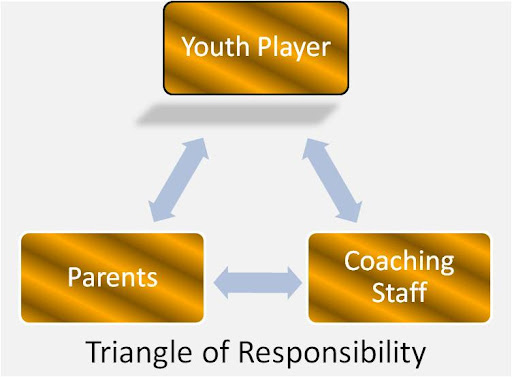
When adults reach for a label to stick on another adult is pushes the sides apart. Tab does that with the “over-protective” moniker, saying parents’ comments are irrelevant to him, and saying parents need to stick to saying something like "good job". Why is that bad? Because Coaches need Moms and Dads, and Parents need Coaches. More accurately, our kids need both. I've mentioned this to friends who are coaches or parents as a “triangle of responsibility between all three.
If any line of the triangle is a conflict or the line doesn't exist (one side just ignoring the other), it distracts and stresses the player. Many parents worry about this potential for conflict, and so in the interest of keeping peace they allow coaches to silence them and make them feel that if they are actively involved with their child they are automatically "over-protective" or a "know it all" or whatever. This creates a situation where coaches sometimes don't feel a need to be respectful with their players' parents. It's humorous to think that we are the customers in this relationship (we pay, right?), yet it's a business with a sign on the door that says "the customer is always wrong"!
I'll be fair, parents say some dumb things about coaching. If a parent said "our coaches only care about the A-team winning", a coach in our academy-level program hearing that would justifiably take offense. Why? Because, like Tab’s comment, it's a cheap-shot oversimplification of the complexity of what they do. Parents who have been around know that coaches of a good size academy program with multiple game-day squads have a hundred variables they are trying to match up on any given weekend. The variable of wanting to win a certain game, while never a bad thing, is just one among many and hopefully is not the ultimate priority.
The point is, Parenting and Coaching both require lots of juggling (excuse the pun), and have complexities that you can’t fully understand unless you live it day to day.
Parenting a youth athlete is more than just getting him there on time (OK, I'm working on that one) and saying
"good job" on the car ride home, as Tab seems to indicate.
There are commitment, character, and sportsmanship issues, often expressed in the effort we see in our child, that I did not sign away each month when we sign our check. The things that go beyond soccer, the life lessons, are still well within a parent's domain and parents should not let a coach or a teacher influence them to neglect this responsibility. Comments after the game by parents about technique and tactics generally just antagonize a kid, lesson learned there from years of being my son's rec coach! And as our kids grow, we are more and more out of the loop to comment on technique anyway- they are moving beyond that stage and we should be glad they are. But there are two other issues in particular that coaches and parents should recognize as a common responsibility:
- Focus and Effort: by showing these, the young athlete demonstrates a respect for themself, as well as dedication in using their God-given talents to the best of their ability.
- Discipline and Sportsmanship: by showing these, the young athlete shows they understand they do not act alone but are part of a greater community. They understand that selfish or lazy behavior can let others down who have put trust in them.
If the work rate isn't there in a match, no one benefits from a parent giving a phony "good job." Straight talk should not be done when emotions in our kid are high, and that is usually the case when you are still on the grounds or in the car afterward. And lets clarify that if parents have that negative, "nothing's good enough" tone and excessive micro-management of their actions, like my own father did, kids tune out and their influence on them is lost. So with care not to do those things, the message must be delivered and not deferred for too long. The child needs to reflect on it while the memories are fresh and clear.
I finally learned through experience from coaching my son's rec teams that I had to stop giving unsolicited advice. I was pretty intense as a coach: encouraging, but intense. A season or two before I stopped coaching his teams (when he "graduated" to the academy program) I saw that I sometimes drove him crazy with my over-analysis. It was enough for me to tell him and the rest of my family that I was imposing post-game rules for myself - I wouldn't give him my analysis of the match unless he wanted to talk about it. It was incredibly hard to keep my mouth shut, but I got better at it.
But is it really always wrong or damaging for parents to talk with their kids about technique or tactics? I think our kids are capable of more maturity than any of us adults sometimes give them credit for. As our kids get older and more experienced in soccer, they are exposed to lots of different ideas, techniques, and tactics. They have different coaches in different leagues and seasons, and they watch a variety of high school, college, and pro matches as well. A mom or dad's soccer talk with their child, used with discretion and timing so not to antagonize them, is just another voice (a voice at times other than DURING a match, of course, that is distracting even to adults!).
Kids develop maturity when they are allowed to navigate through what they see and hear from multiple adults and apply what works best for them. Building maturity and decision-making skills in a youth athlete are goals that coaches and parents have in common, and are lessons that extend beyond the field. Parents and coaches won't be as successful achieving that goal as partners if we just abide by some silent truce between us. My son and his U11 teammates have a quickly developing "bs detector", and giving them true observations is a way to treat them like the young men they are becoming. Our kids can handle more of the "raw truth" with each season, and they can also increasingly sniff out bs if adults serve it up to them. As long as parents and coaches don't get on a power trip, a few differences of opinion among us won't scar our kids.
In addition to the rules for myself that I mentioned, I made a few rules for my son for that post-game period. I did not allow my son to vent negative comments about officials or bad-mouth an opponent. Mainly, I didn't want him to fall into that "victim" mentality" after a loss or tie. That rule started when I noticed my son sometimes obsessed about bad or missed calls after a loss, so I just said that stuff is off limits right after a game. Doesn't mean I didn't agree with his opinion, just that I wouldn't jump on the "blame" bandwagon with him. I also have topics that I may discuss with my son's Mom that I would not include him in, it would be inappropriate. So a coach shouldn't assume that if a parent is agitated and brings up an issue that the parent has also "pissed in the well" and made negative comments to his child. We can go back to my triangle and see, there is a line across the bottom of the triangle that does not include the player.
Instead of saying parents should "stay out of it", coaches would do better to simply ask parents to "stay out of the results business." There is a very important difference in focusing on a child's effort versus focusing on the results they achieve. Here is a scenario: a child just mishit a potential game-winner. The parent says loudly and publicly, "why didn't you keep your head down, you weren't even close." Contrast that with a parent who has seen his child looking lazy in marking opponents or moving too slowly to keep up with game transitions. The parent tells his child, "I could tell the other team really wanted that victory, when you play a team like that you can't be out there walking around if you want to win."
There is a big difference in the methods of those two parents. But because the similarity is that in both cases the parent tells the child something they don't want to hear, the fine points of difference between an enlightened and an ignorant parenting strategy are lost on others. They see the child's negative reaction, and assume they are both a case of too much parental involvement.
Now, let me talk about a scenario closer to home, and one that Tab Ramos actually hit on: a parent commenting on playing time. A parent noticing that his son is sitting out a lot is not necessarily an obsessive, over-protective parent. It canalso be a parent that has worked hard with his child to get them to demonstrate commitment and effort, and now wonders about the reciprocity in that child-club relationship. I brought something about my son's playing time after a tournament, and I knew the danger was that I could be pegged as a Dad who obsesses about time and stats, which I don't. I often don't even know when the half will end when someone asks me! It was not obsession, but simply that concern that pops up in any relationship about give and take.
My son sensed I was irritated about something in that instance, and he asked. I told him I just didn't understand why he got so little playing time at the first tournament when he had played and contributed a lot with that same squad in the fall. I added "Look, your coach mentioned something to me about being late for a couple of warmups, and that is my failure, and I am going to have to fix that. But I'd just like to know if there is something else. Have you been giving it your all in practice, are there things you could help me understand?."
I got a well thought out answer from my son, and he actually opened up about where he felt he had "slacked" a bit in some practices and how a couple times he had been confused about a certain skill that other kids picked up more quickly, and a couple of kids teased him about. I found this similar to some things we had worked on with his school due to his ADHD, so I asked him to show me one of the moves that had stumped him in practice. He took a ball out and worked the skill several times on the living room floor. He used some skills he's learned from tutoring: if something like that had him feeling "inferior" he could always find somewhere, such as at home, where he could work it at a slower pace and break it into simple steps that helped him to nail it down.
My son's response had a maturity that impressed me. Funny thing, he had an issue that was bothering him over that same week or two, but it was different from the playing time issue that had bothered me. With him, it was that the team he played on in the second tournament was a mix where it was very difficult for him to find guys on the field to work with. He mentioned that his pairings up top at forward meant that most of his passes when working an attack just resulted in his teammate losing possession or missing a great opportunity to strike.
I told him I knew that player rotations were good for the overall squad and it's a basic academy concept, but that I understood his frustration since sometimes it results in big differences in teammate skills.
About a week later, my son came to me without prompting, and just said, "Hey Dad, you know how I told you sometimes I felt I slacked in some practice drills, well I'm not doing that, I'm working at everything. And the team stuff doesn't matter, I know that I can play awesome whatever team they put me on, it's fine."
Perfect outcome, and most importantly my son found a new maturity in looking at practice and teammates, and a hidden cache of passion for the sport that I'm not sure he knew was in there.
So, as coaches ask us to trust them, sometimes they need to trust us parents. When we act like idiots and shout things like "shoot, shoot" from the sidelines when our child is at midfield and has an opponent in his face, we cut our chances of that, for sure.
As young players grow, we Moms and Dads must move away from the Barney days of "it's all great" and find opportunities to talk about things with our kids on a more adult, or young adult, level. We need to let them drive it, let them indicate what they are ready for, and keep OUR opinions out of it, but raising an issue about effort, teamwork, or sportsmanship when appropriate is a key part of parenting a young athlete. Sometimes the simple "good job, you tried hard" comment isn't reality, and it's in those situations when real parents step up.